BLOG RACE

Check out the content of our blog, where we bring the main trends in the communication area, as well as tips and other insights written by our entire service team.

Communication and trust

Trust is a state of mind. A way of looking at life in a positive way. Open to the other as a possibility of sum. Entrepreneurs and founders of big business (small ones too) are trusting people. They believe in their individual talent, believe in their product, service and believe in their dreams. These makers are like a beacon to light the way, to guide people and customers through the market seas. To open borders and do extraordinary things, unthinkable for many.

One of the best images to illustrate confidence is that of two trapeze artists in the air. We were astonished at their synchronicity and their absolute mutual trust. The risks of these maneuvers are very high. From a serious injury to death. The end. Companies and brands also live on this issue, every day. Can I trust my employees? Are they engaged in fact or do they not mean it? Can I trust my supplier? Can I trust my director? Will he meet the agreed deadlines? Can I trust the government? The banks? Can I trust my partners?

As a business communicator and professor, I can only embrace the idea of ​​trust through the ability to dialogue. Ability and commitment to the truth conveyed by words. Do companies and brands know how to dialogue? Do they really want to dialogue and build trust? Long-term bonds? I believe that this is the greatest contribution of the field of communication: strengthen ties through dialogues with multiple stakeholders. In a strategic, intelligent and transparent way. There is no confidence if one part is based on lies as a business strategy. If you promise anything, even knowing that you will not keep your promise. Worst of all worlds is finding companies within which sarcasm and hypocrisy have taken hold of the environment and people do not tell the truth.

Trust is the foundation of sustainable businesses, of brands that are perpetuated by generations in the market. And they all know not only how to inform their stakeholders, but how to communicate. They really know how to talk, like two great friends when they meet. The conversation reduces risks because it brings people together to get to know each other before making commitments. Imagine if these two trapeze artists do not talk?

Can your company be any different? Best regards and thanks for reading.

By Luiz Gaulia

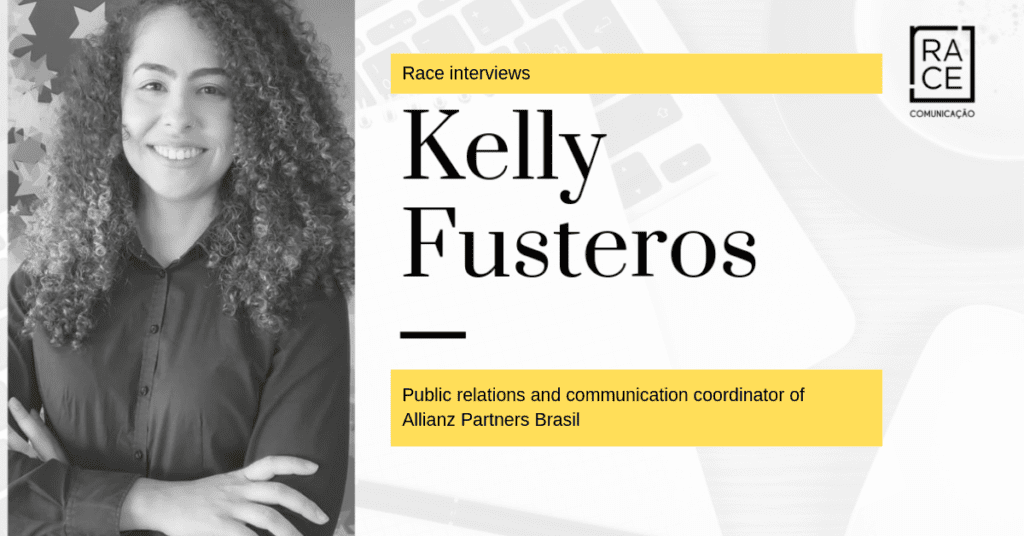
Race interviews

The internal communication is a department planned and with scopes determined so that there is the interaction between the company and its collaborators. With it, one can enhance relationships and increase productivity, engagement, and even an organization’s financial outcome.

And so, today’s post brings an exclusive interview with the public relations and communication coordinator of Allianz Partners Brasil, Kelly Fusteros. With more than eight years of professional experience, Kelly followed the changes in the behavior of the companies, mainly the concern for the well-being and the good fellowship of the collaborators.

‘Internal communication plays an important role in companies that cherish a pleasant professional environment.’

In this interview, you will understand the important role of internal communication in companies. Check it out!

Race Communication: How important is internal communication to the company?

Kelly Fusteros: Every organization is made up of people and they are the ones who, working together, will lead the company to achieve its goals and results. The first objective of the Internal Communication is to inform employees about what happens in the company and offer content that can be added in daily activities. Secondly, internal communication has the power to act in the organizational culture, in the dissemination of goals and objectives, and in the engagement of employees.

Internal communication, when it acts strategically close to the board, goes beyond the limits of just carrying information. It engages the collaborator, making them feel part of a “family”, of something more, of seeing meaning in his activities, of linking them with goals, to the point of transforming them into an internal influencer and ambassador of the brand. Internal communication takes transparency, passes a single speech and must always be two-way, that is, senior management for employees and vice versa, thus helping to mitigate false rumors and news within the organization.

RC: How to think about strategic campaigns for this audience? KF: Firstly, it is important to know employees by analyzing quantitative data (number of employees, percentage of men and women, age, region of residence, turnover, percentage of employees in the administrative area and operational area, among others) and qualitative information (annual survey, active listening in corridors or cafeterias, discussion groups, visits to the different areas, meeting with focal points, etc.). With this information, professionals in the area of ​​Internal Communication can draw a profile of employees and what should be the approach: if employees are younger, communication channels and proposed actions may use a more easygoing language, light, with visual that is closer to what this public consumes externally, such as memes and videos; if the employees are from the legal area, for example, it is important to know the terminologies and processes; if the turnover is high, it is necessary to frequently work on the key messages, because the turnover of people impacts the culture and engagement.

One tip is to create a persona, which is the simplified representation of your collaborators, a character who will help communication to better understand who the collaborator is and what he needs.

From these points, the Internal Communication must base its planning on the company’s goals and objectives and on how to transmit this information to the persona in an effective way, considering its characteristics and desires, and engaging it so that employees and company walk in a same direction.

RC: Do you believe that organizations make correct use of internal communication to improve the relationship between employees?

KF: Nowadays, I believe that companies are using internal communication to create a relationship and establish an affective link and interactions between the employer brand and employees.

Among different areas, internal communication can help to break the silos, promoting actions and campaigns of interaction and collaboration, such as a magazine or internal newspaper, in which collaborators interview and create content from other departments; sporting championships; race groups; singing or theater classes; voluntary actions; etc.

RC: Why did the culture of adoption of internal communication campaigns take time to be incorporated by medium and small companies?

KF: Communication is inherent in every organization. It exists in the day to day and the great difference is the company to appropriate from it formally or not.

Having good communication has become essential for any organization, as professionals are increasingly searching for workplaces that have a healthy environment, are more concerned about their well-being, about the value of their work, are more critical about the performance of organizations and their transparency.

Small and medium-sized companies took time to understand internal communication as a tool that would help them to have more synergy to achieve their results and integrate collaborators. Often, these organizations are family-owned, which may imply even greater resistance to the deployment of a two-way communication.

RC: What are the main obstacles hindering effective internal communication?

KF: The lack of strategic participation in top management decisions is the biggest challenge, as I see it. The direction of the company needs to have a clear vision of the important role and value that the area of ​​internal communication has, involving it in moments of decision.

Low investment and outdated technologies are the second biggest challenge. Creativity is inherent in Communication professionals but having the budget to invest in engagement and recognition campaigns, for example, can be the differential to change the organizational culture. It is also important to invest in more modern channels, such as intranet and Corporate TV, with more attractive, intuitive and easily updated layouts.

RC: What are the benefits that internal communication can bring to the organization?

KF: Effective Internal Communication brings better financial results to the organization, as it increases the productivity and the length of stay of the employees in the company, besides making clear the strategies and objectives of the organization, showing the impact that each activity performs in the whole.

It also strengthens culture, encourages good behavior, engages employees, helps break silos, and increases collaboration among teams.

RC: Do you believe technology has brought big gains for internal communication?

KF: Absolutely. Our world is more and more digital, the way people communicate is undergoing transformations and all this evolution is a constant form of internal improvement. Integrated communication technology optimizes processes and increases productivity, bringing greater speed, ease and effectiveness to the communication team. It is also possible to better measure results and impacts.

For the target audience, technology provides rapid information delivery, more interactive channels that take into account user experience and facilitate a two-way communication. Besides the environmental gain with the decrease of the use of paper and other disposable items.

RC: What tips would you give to companies that want to deploy internal communication efficiently?

KF: I believe that the first step is to develop a culture of communication, working together with the high leadership for the success of the organization. Establish the company’s official communication channels: intranet, corporate social networks, newsletters, announcements, corporate TV, among others. In addition, ensure that company leaders have undestand and use them for official communications. Also carry out an Internal Communication Plan to diagnose strengths and opportunities and plan the campaigns of the year. And by putting it into practice, make connections between what employees do on a day-to-day basis for the purpose of the organization, providing insights into the objectives and results to be achieved.

Face-to-face communication campaigns are a great way to create a connection with employees. Then bet on opportunities for contact, such as events with leaders and with the president, dynamics that ensure interaction between areas and feedback. And whenever possible, measure your results quantitatively and qualitatively to see if your campaigns are effective and so you can always show the value of internal communication to the company.

RC: Why do many companies delegate internal communication to the HR department? Should not this kind of work be done by the communication department?

KF: Some organizations have the old perspective that employees just want to be informed of their benefits and that a good working environment is created only by the Human Resources team. As we’ve spoken, the engagement and the time of permanence of a collaborator in the company goes beyond the benefits offered by the company.

Researches point out that employees prefer a company that values ​​communication and open dialogue with their leaders over one that offers great benefits, demonstrating that the benefits will not fill the lack of dialogue, feedback and good relationships. The Internal Communication area has the appropriate knowledge and tools to engage employees and lead the organization to success.

By Evelyn Spada

The advent of corporate social networks and the new PLC being

The new forms of social, relational and mediatic interactions, the breaking of paradigms and innovation have made society, especially Brazilian society, assume a new world configuration. Increasingly present, the word “reconfigure” entwines physical and virtual space, incorporating itself into the context of society in all spheres. In organizations, it is no different. The era of standardization of PLC being is over. Although there are still fundamentalist adepts, the imposed whole has dissipated every day. As portrayed by Zygmun Bauman, Polish sociologist and philosopher in “liquid modernity,” everything is volatile, human relations are no longer tangible.

In an open world, full of possibilities, connectivity, communicational and social plurality, where technology is a real extension of man, the term Global Village, used by Herbert Marshall McLuhan in his works “The Gutenberg Galaxy” (1962) later, “Understanding Media: The Extensions of Man” (1964), confers veracity to contemporary society. The values, concepts, principles and rules, which until then were only dictated by social organizations, are increasingly distant from postmodern man.

Today, the employees of a company do not want to be known as mere workers, operational – they aim to have voice and constitute a new PLC being.

In this scenario, corporate social networks emerged, important tools not only for the establishment of internal communication of excellence, but also for the empowerment of a new business being.

Corporate Social Networks: Benefits and ChallengesIn the digital age, whether at work or at home, people invariably spend too much time in front of computers, tablets, smartphones, and other devices. Socializing on networks is the existential reason that moves postmodern humanity. According to data from Hootsuite and We Are Social, released in 2018, 62% of the Brazilian population is active on social networks, and 58% have already searched for a service or product through the internet.

If used strategically, the corporate networks are excellent options for an establishment of culture of excellence of internal communication, because through the tool it is possible to improve the organizational climate; establish dialogue between the entities, with a mutualistic communication, which does not privilege unilateral relations; engage the team; empower participants, since there is space for the development of new ideas, processes, services and products; retain talents; and even identify organizational gaps, reducing communication and turnover crises. But what is a corporate social network?

“Grandchild” of the old intranet, they are platforms that bring together professionals from an organization, creating a communication chains. Like open social networks, these systems, targeting an audience of an organization, which can be collaborators or other stakeholders – in some cases suppliers, partners and even shareholders -, bring together people around common interests. Depending on the platform, it is possible to write content, share, enjoy, create communities and even talk in private mode with a user.

It is noteworthy that the establishment of dialogue provides growth, since, when communication is potentiated, cherishing innovation and creativity, there is a latent flow of thoughts, but this does not mean that relationships should not be mediated.

Although the advent of social interactions in the digital environment contributes to the dissemination of knowledge, rapid communication, opening of new markets (technological and human) and innumerable other benefits, without mediation, networks become a major threat to the image management and the reputation of the organization, which could be exposed to the unpredictability of phenomena and to ideologies with strictly opportunistic and personal ends.

In addition to mediation, in order to succeed, by acquiring a market platform or by developing a corporate social network of its own, it is imperative for organizations to be clear about the real purpose of the project and to convey the ideas to the participants.

To make it strategic and meaningful, there is no point in just making network access available to participants. The tool should be part of an integrated communication plan, have a solid policy with processes that justify its use, with a strategy that contemplates the role of mediators; network structure, indicators and performance measurement, such as employee participation; opportunities, points of attention and gaps. Still, it is salutary to remember that the adoption of the network does not exclude other communication tools. Especially when it comes to internal communication, the use of platforms from various means, such as house organ, wall newspaper, Corporate TV and others, facilitates access to information easing communication and bilateral relationships. In short, you cannot think that the results will appear if there is no prior planning. In communication, planning is the key to success, especially when it comes to attracting and relating to the new PLC being.

By Rodrigo Freitas

Gamify yourself

A strategy increasingly used by the corporate world, the gamification engages employees, joins teams and retains customers

With the advancement of technology, the world is increasingly connected and fast. The dense exchanges of information and the very high circulation of digital content represent great challenges for companies, which compete for the attention of the public. Retaining stakeholders is almost an impossible mission for a business that does not generate identification, engagement and interaction.

And one of the main targets of organizations is precisely “in the house.” The relevance that employees have for disseminating the values ​​and missions of companies is notorious. Undoubtedly, they are one of the company’s most important showcases. To the inner public, the message must be clear, and the noise exterminated. For these purposes, gamification has proved to be a powerful strategy.

This is a set of engagement techniques that encourage participants to achieve certain goals. In this case, those of the business. Despite the name, it’s not a video game. The tool has used the creative, playful and interactive features of the gaming industry to solve problems and overcome the day-to-day barriers of organizations. To this end, it works with concepts of competition, cooperation, exploration, awards and storytelling.

The foundations of the solution are well grounded, and explore many areas of knowledge, such as psychology, neuroscience, game and learning theories, anthropology and sociology.

Because it is very versatile, the strategy fits into different situations, sectors and types of business. Schools, large and small businesses, hospitals, prisons, hotels, any context can be gamified, taking into account their specificities and objectives.

No wonder, there are several cases of success in the market that demonstrate the effectiveness of the tool. The most impacted indexes are attraction, engagement, retention and conversion of clients and employees. In clear English, gamification has the power to increase sales, attract new consumers, and intensify teamwork – goals that every business struggle to achieve.

The office is no place for games. Says who?!

By Thiago Eid


5 strategies to find a way out of obvious in internal newsletters

When before us are modern and bold communication possibilities, such as new apps, platforms for finding digital influencers or SEO tools, thinking about the old and classic newsletter seems little innovative or exciting. However, despite seeming an old tool, newsletters still represent an efficient and necessary way to start conversations, generate leads, and maintain an intimate relationship with a company’s stakeholders. What is at stake is the efficient use of this feature in a way that attracts the receiver’s attention. Easy to say, challenging to perform. How to find the ideal measure in a universe of organizations with such diverse goals, that communicates with people so demanding for quality content? Thinking about this resource as an internal communication strategy, I have come up with some ways that can help us plan newsletters in a more strategic form:

  1. Spend some time on benchmarking

Studying the market is the first step in understanding what context your customer is in and how their competitors communicate. Use market references in your favor and understand how this would apply to the internal audience to which the newsletter is aimed. With this background, it is much easier to define a starting point to differentiate and communicate with quality. At this point, it is worth analyzing all the examples, whether they are aimed at the consumer (external) or the internal public of the companies.

2. Study the business objectivesMaybe your client already makes newsletters internally and wants to follow the same strategy when working with a communication agency. However, it may also be that your analysis conveys that the company should follow the opposite path. To identify this strategy gap, there is nothing better than revisiting the business objectives with this mean of communication: bringing the whole team closer to management issues, generating engagement in the communication tools of the company, promoting interaction among teams, adapting employees to a new organizational culture , among many others.

3.       Investigate the interests of the publicAdvertising has tightened many ties with communication when both areas realized that brands need to deliver relevant, quality content rather than always tying the company’s image to sales. This is a very present debate in our field, and it is also important to produce materials for internal newsletters. Think of the company’s mailing as their final consumer group. In this sense, move away from the cold institutional and protocolic bulletins and actually study the habits and interests of these people.

4.       Deliver quality contentWith the above points, we have acquired providential information to carry out the job: we know the context in which the company is inserted, we have identified the objectives and the target audience. From there, it is possible to structure guidelines and contents that really arouse interest and engage readers. Do not bet all your coins on communicating company actions – use your public learning to provide materials on industry trends, market movements, and discussions on important issues in the company’s vision (gender equality, HR practices, innovation etc.).

5.       Integrate the company communicationIf your job also involves managing the website and the social networks of the brand, worry about the integration of all these channels. It may be that some of the employees are not heavy users of the networks, and the newsletter is a great opportunity to call them to company profiles. Producing a more technical content for the newsletter with a call to action for a related post in the institutional blog can be a good way out, for example.

What other ways do you use to get out of obvious answers in the production of internal newsletters? Leave a comment!

By Amanda Lima


No matter how good, progressive and avant-garde your plans for the growth of your company are. They are in serious danger of failing if you are not successful in communicating them to your employees. This is where a fundamental tool of corporate communication comes in: internal communication.

A good internal communication network can help in collaboration, feedback and the application of a transparent relationship in the company. For these and other reasons is that it is such an important tool of relationship in companies of any size or segment.

Firstly, it is worth remembering that internal communication will be a strong ally for the alignment of different areas of the same company. Lack of positioning will surely undermine your productivity. Let’s imagine for a moment that the company’s marketing team wants to promote its products. The area should be in line with other sectors to know where to invest, which products have higher and lower demand and what the goals of this promotion are.

As a leader of a company, it is important that you inform your employees what your purposes are. Internal communication is an effective tool for sharing goals, plans and responsibilities.

What’s more, there is no employee who does not want to feel validated, listened to, and a member of a team. A well-structured company has motivated employees and, to deliver that value, a well-built internal communication project is ideal. It can be an important channel for the recognition and celebration of good practices and goals. This will help create a culture of appreciation in the company.

The company should be the owner of its information. Internal communication can counter hallway gossip. Just as journalists look for official sources to find out about certain subjects, your employees will come to you – and your mean for informing them will be an internal communication project.

And last but not least, internal communication will be a good friend to have alongside in internal or external crisis situations. People say that at times like these, executives must preserve themselves and talk as little as possible to avoid exposure. However, knowing what, when and how to communicate can turn a catastrophic situation into a positive scenario, in which the executive will be surrounded by allies.

Interested in investing in your company’s internal communication? Ask us how.

By João Pedro Andrade

Automation in Instagram: you can´t be too careful

By Bárbara Christan We are living the peak of Instagram. The app has been gaining form in recent years, increasing its base and reaching other age groups – parents, uncles, aunts and grandparents are migrating to the network. Suddenly, everyone plays the role of photographers, seeking the best click, and influencers, sharing consumer habits, books they liked, movies they watched. In this channel, each person is a creator of unique content, also disclosing opinions on

Leia mais »

Digital marketing: ADS what are they

By Vanessa Assis In digital marketing, ADS are advertise embedded in some sites, such as Google and Facebook, that serve to attract audience. They serve both for the dissemination of paid products and for free content. For example, if the company wants to release an e-book (which can be accessed at no cost to readers) on how to improve production processes, one can disclosure it through this type of advertisement. They can be purchased in

Leia mais »

Highlights in Costumer Service 2.0: first-person institutional positioning

By Amanda Lima In the digital environment, the concept of Customer Service has taken an up-to-now unknown proportion. As everything concerning the operation of enterprises in social network, experimenting, testing formats and strategies to understand how these new platforms would work was needed. The term Costumer Service 2.0 is nothing more than customer service for digital channels, with a difference that I consider to be primordial compared to the traditional model: on the web, impersonal

Leia mais »

Twitter: 280 characters that can decide information

By Gabriel Pedreschi Who would say that, 13 years after joining the networks (21/03/2006), Twitter has become one of the best and greatest means of communication, with great agility, great volume of sharing and, often when we think about journalism, the place where breaking news are shared. All this in 280 characters. The growth – or importance – of Twitter is shown by two factors: in numbers and how the network is being used in

Leia mais »

How to create integrated communications

By Filipe Andrade Establishing corporate communications, whether internal or external, is by itself a huge challenge; when well executed, it makes all the difference to an organization. When it doesn’t, it can have a tremendously negative impact. Integrating both internal and external communications, forming a synergy between them, is a separate challenge. The result of an integrated communication, however, is substantially higher than any result from them separately. To understand how to do internal and

Leia mais »

Case: Surprise Box | Ajinomoto

Race Communication develops customized gifts that meet every type of budget and specific need. This service is an effective tool that reinforces the importance and relationship with your audience of interest, whether they are internal or external. Campaigns aimed at journalists and digital influencers are performed through press kits, which are sent with the goal of disclosing a brand, event or product launch. For each case, we elaborate a strategic plan that involves collecting mailing

Leia mais »