
BLOG RACE

Check out the content of our blog, where we bring the main trends in the communication area, as well as tips and other insights written by our entire service team.

By Bárbara Christan

We are living the peak of Instagram. The app has been gaining form in recent years, increasing its base and reaching other age groups – parents, uncles, aunts and grandparents are migrating to the network. Suddenly, everyone plays the role of photographers, seeking the best click, and influencers, sharing consumer habits, books they liked, movies they watched. In this channel, each person is a creator of unique content, also disclosing opinions on political and governmental topics.

As a result, communication and digital marketing take advantage on this growth and develop ways to obtain and measure results. And that’s where automation tools come in, helping influencers and salespeople get their way across the network.

Currently, there are several tools that automate practices that people do organically in their networks, such as following profiles and hashtags, liking and commenting on publications, scheduling Instagram Stories and sending direct messages. With this automated flow, the growth of profiles is accelerated, and the tool performs all these actions. With the increase in the base of followers, the other metrics consequently rise. But caution is needed in this automatic process.

The end of automation is decreed by Facebook

In 2016, Facebook announced the depreciation of the Instagram API. API – Application Programming Interface – is a set of features that allow integration between systems and applications; they standardize and facilitate the data integration process. It allows the development of app that use the Instagram framework and provide better forms to use the platform.

With it, there are no more resources, such as: following and stop following, automatic commenting, automatic likes and dislikes, following the list of someone who follows a specific person, among others.

This change has been active for three years. The automation tools continue to function normally, however, they are considered irregular according to Instagram policy. And so, several accounts have been discovered and canceled by the network eversince.

What now?

Even with multiple accounts being deleted, some people and even brands continue to use automated features – either because they believe they will not be “caught” by the network or even by lack of knowledge. But for those who want to build solid work on social medias, careful and detailed planning is needed.

Get to know your audience, understand their sorrows and needs, create relevant content with their own style, and look for a visual identity that matches to their positioning and goals. And when planning and putting everything into practice, having the service of a specialized communication agency is essential to reach the desired numbers.


By Vanessa Assis

In digital marketing, ADS are advertise embedded in some sites, such as Google and Facebook, that serve to attract audience. They serve both for the dissemination of paid products and for free content. For example, if the company wants to release an e-book (which can be accessed at no cost to readers) on how to improve production processes, one can disclosure it through this type of advertisement.

They can be purchased in cost-per-click templates, or by print (every time it is displayed to a person, it is printed on a web page), or reach, video time.

Usually this type of service is sold per thousand (cpt = cost per thousand), or by video views. Nowadays the main players are Google Ads and Facebook Ads, but there are also other platforms, such as LinkedIn Ads, UOL Ads etc.

Why using Ads?

Ads is one of the best ways to get the attention of people who may not know your brand or who are in need of a product. The great advantage of using this type of strategy is that it allows the ad to be targeted to the right person (target audience) because the brand is displayed to those who are looking for that type of product or service, using key-words search or preferences.

Each Ads service has its particularity. For example, Facebook Ads does not work with keywords so much, but through people’s interests, or based on pages that people like or follow. For example, when there is the need to reach the public for the sale of fitness food products, it is possible to direct the ads to users who enjoy pages of the same segment (health, sports, healthy eating, etc.).

Who should use it?

Any company who wants to have digital marketing return, needs to work with Ads. That’s because Ads is a complementary way of attracting people who have an interest in a product or service, so it’s a form of advertisement.

When to use?

It is very important that the use of Ads is allied to a strategy and that its usage is not based only on the fact that other companies are using it. These ads are important when you have a strategic plan on what you want the user to do.

It is necessary to know the target audience. If the brand does not know what wants from them, it does not make sense to use this means of publicity, as there will be expenses with ads that will not be converted into sales.

By Amanda Lima

In the digital environment, the concept of Customer Service has taken an up-to-now unknown proportion. As everything concerning the operation of enterprises in social network, experimenting, testing formats and strategies to understand how these new platforms would work was needed. The term Costumer Service 2.0 is nothing more than customer service for digital channels, with a difference that I consider to be primordial compared to the traditional model: on the web, impersonal and institutional discourse does not have so much space. You have to take on the first person.

Costumer Service 2.0, the model of customer interaction in social media, requires the creation of a persona that suggests a real conversation with users. Therefore, it is mandatory to assume another type of language, which represents the voice of the company in a personalized way and that is aligned with the realities of those who consume the content disclosed in the profiles of the brand – watching out for the trending topics of the internet is essential to speak as an equal with the fans.

Another key element is frequency: interacting as much as possible is indicated not only to increase awareness and to strengthen brand identity, but also to promote a closer relationship with consumers if they have complaints or problems with particular products.

In this scenario, when it comes to a small business, with a smaller geographic reach, it is easier to standardize communication and come up with a more humanized, personalized and close costumer service. However, when it comes to market giants, it is necessary that the entire team in charge of the company’s digital communication is aligned and speaking the same language.

With that in mind, I highlight below three brands that stood out as I evaluated how they interact with their fan base:

Pepsi

When I think about brands that I admire for the quality of the interaction with the audience on social media, one of the first that come to mind is Pepsi. In December 2018, I was impacted a few times by publications of their official page, thanks to the Street Rock Festival, event sponsored by the company and disclosed on social media.

Although the Pepsi fanpage has a low frequency of publications – which fails to take advantage of the huge fanbase the profile has, with more than 37 million likes – the language adopted by the company in Costumer Service 2.0 represents very well the brand identity. On copy – the text that follows the post -, emojis, abbreviated words for internet language, hashtags, the latest memes and also a text description to make the content accessible to the visually impaired, with the hashtag #PraCegoVer (#ForBlindsToSee).

Despite using a current outfit, this persona that interacts with fans uses the same DNA Pepsi used on television ads from when Pepsi Twist was released, for example, and that was almost twenty years ago (yes, time goes by much too fast).

But we were talking about Costumer Service 2.0. In the post above, besides being present all the mentioned elements, it is possible to observe a little of how the company responds to comments. Benchmarking wins.

Nubank

I could easily make a post exclusively on Nubank’s (a digital Brazilian bank) omnichannel strategy. The fintech, that was recently voted by Fast Company Magazine the most innovative company in Latin America, has integrated service channels and puts into practice the full recipe for caring and humanized treatment that certainly boosts its engagement rates in social networks.

In the interactions, GIFs, purple heart emojis and a lot of good mood. The publication below is just an example, but it is worth browsing the page and getting to know the company strategy closely.

Netflix

Last but not least: Netflix, perhaps the most obvious choice to figure in a discussion like this. Every communication professional and / or TV series lover has had some kind of admiration for the way the company takes advantage of the potential of social networks to promote the brand.

The identification of the fans with the company’s persona is so strong that most of the comments left by the users are already aimed to this virtual entity that interacts with the publications. In this case, the adaptation to the language of the public is the great differential.

The bottom line is that, as important as producing interesting and quality content, Costumer Service 2.0 represents a central strategy to keep the user engaged and identified with a particular company or the concepts it seeks to promote.

Looking for social media services for your business? Contact Race.

By Gabriel Pedreschi

Who would say that, 13 years after joining the networks (21/03/2006), Twitter has become one of the best and greatest means of communication, with great agility, great volume of sharing and, often when we think about journalism, the place where breaking news are shared. All this in 280 characters.

The growth – or importance – of Twitter is shown by two factors: in numbers and how the network is being used in the disclosure of news and brands, even by governments. First, let’s talk about the numbers:

Last February, when announcing the balance sheet for fiscal year 2018, the American company, compared to 2017, had a growth of 25% in revenue (US$ 3.04 billion) and 24% in advertising (US$ 2.6 billion). If you only count the fourth quarter, the network showed growth of US$ 908.8 million (20% compared to 2017).

Brazil

Leaving the numbers aside and moving on to the issue of communication, Twitter, for its strength of share, has great agility to replicate information, whether positive or negative. A current example is the use of the tool by the Brazilian Executive Power, which adopted the platform as a way of publicizing the actions being taken by the Federal President.

Sports

The blue social network has also become a way of bringing fans closer to their idols or sports team. An example of a recent approach is the Santos Futebol Clube’s account, which since 2018 has been interacting with fans, either through emojis or more elaborate answers, from jokes to “invites” to the fan to attend the team’s next games.

When we analyze, just for the sake of agility and approach, Twitter is the perfect platform. But the user must remember that, in case of a wrong message or a failure, whether on or off the network, the crisis management team must be ready to act quickly. After all, if there is agility for positive news, it will double in negative situations.

By Filipe Andrade

Establishing corporate communications, whether internal or external, is by itself a huge challenge; when well executed, it makes all the difference to an organization. When it doesn’t, it can have a tremendously negative impact.

Integrating both internal and external communications, forming a synergy between them, is a separate challenge. The result of an integrated communication, however, is substantially higher than any result from them separately.

To understand how to do internal and external communication in an integrated way, we need to first understand the specifications for each one of these ways of communicating in an organization.

Internal communications are commonly understood as a process of exchanges between the employees of an organization, involving all the team in the communicative process and the informative contents, whether vertically or horizontally. There are several internal communication tools and many ways to use this type of communication in a strategic way. The important thing is that this communication  needs to be taken seriously, and even more importantly, it needs to be considered as strategically relevant by managers.

External communications on the other hand, has an even more institutionalized and hierarchical character. This because, in these cases, there is a second filter inside the organization – not everything that’s relevant to the internal public is relevant to the external. And, unlike internal communications, which aims to integrate the team, the external aims to bring the organization to public attention, to be seen and recognized as such. This communication often happens through the work of the press office.

Integrated communication goes beyond. “[…]It presupposes not only a productive dialogue, but a joint planning. The decision-making process, which should include other instances of the company or entity apart from those specifically related to the communication/marketing, must be shared, even if there is a boss, a superintendent, or a general director to whom everybody reports to”, as argued by authors Cláudio Silva, Flávia Schroeder, Luciana Costa, Mariana Cumming and Ticiana Diniz, in the article ‘Comunicação Integrada como Ferramenta de Gestão’ (‘Integrated Communication as a Management Tool’).

The result of the integrated communication is a company image that is much more aligned, more global — as the authors mentioned above point out –, highlighting each sector of the corporation, its activities and specifications. And, even if it’s something new in the market, this is not just an option, but a necessity and a distinction in an organization. A trend that points to the future.

If your company needs help developing a way to work with communication in an integrated manner, please contact the specialists at Race Communications. We’d be happy to help!

Race Communication develops customized gifts that meet every type of budget and specific need. This service is an effective tool that reinforces the importance and relationship with your audience of interest, whether they are internal or external.

Campaigns aimed at journalists and digital influencers are performed through press kits, which are sent with the goal of disclosing a brand, event or product launch. For each case, we elaborate a strategic plan that involves collecting mailing with specific data for its purpose.

To celebrate the 60th anniversary of Ajinomoto do Brasil, Race prepared an interactive press kit, which generated a dynamic among the participating influencers. Priscila Santana, Ajinomoto do Brasil’s communication manager brings more details about this developed campaign:

Caixa Supresa was a very cool campaign we did with Race. The idea was celebrating the 60th anniversary of Ajinomoto do Brasil and, to this end, we invited some influencers and youtubers to a challenge.

We set up 10 boxes containing different Ajinomoto products, along with other ingredients, and challenged them to prepare a creative recipe with what they had received. The coolest part was that after developing the recipe, the person had to challenge a colleague to do the same by sending one of the boxes.

We had an excellent result, with super different and creative recipes. In addition, the impact was very significant: more than 1.6 million people.

This was an extremely positive action, as well as fun and, of course, delicious.

Priscila Santana, communication manager of Ajinomoto do Brasil

Do you want to know more about the campaigns with influencers developed by Race? Contact us!

Communication and trust

Communication and trust

Trust is a state of mind. A way of looking at life in a positive way. Open to the other as a possibility of sum. Entrepreneurs and founders of big business (small ones too) are trusting people. They believe in their individual talent, believe in their product, service and believe in their dreams. These makers are like a beacon to light the way, to guide people and customers through the market seas. To open borders

Leia mais »
Race interviews

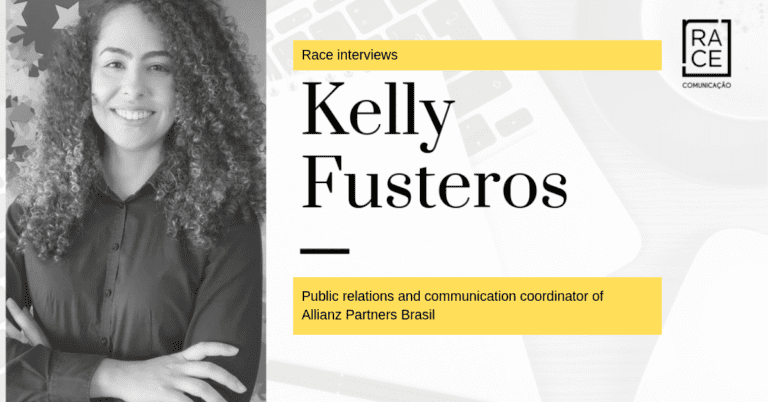
Race interviews Kelly Fusteros, public relations and communication coordinator of Allianz Partners Brasil

The internal communication is a department planned and with scopes determined so that there is the interaction between the company and its collaborators. With it, one can enhance relationships and increase productivity, engagement, and even an organization’s financial outcome. And so, today’s post brings an exclusive interview with the public relations and communication coordinator of Allianz Partners Brasil, Kelly Fusteros. With more than eight years of professional experience, Kelly followed the changes in the behavior

Leia mais »
The advent of corporate social networks and the new PLC being

The advent of corporate social networks and the new PLC being

The new forms of social, relational and mediatic interactions, the breaking of paradigms and innovation have made society, especially Brazilian society, assume a new world configuration. Increasingly present, the word “reconfigure” entwines physical and virtual space, incorporating itself into the context of society in all spheres. In organizations, it is no different. The era of standardization of PLC being is over. Although there are still fundamentalist adepts, the imposed whole has dissipated every day. As

Leia mais »
Gamify yourself

Gamify yourself!

A strategy increasingly used by the corporate world, the gamification engages employees, joins teams and retains customers With the advancement of technology, the world is increasingly connected and fast. The dense exchanges of information and the very high circulation of digital content represent great challenges for companies, which compete for the attention of the public. Retaining stakeholders is almost an impossible mission for a business that does not generate identification, engagement and interaction. And one

Leia mais »
5 strategies to find a way out of obvious in internal newsletters

5 strategies to find a way out of obvious in internal newsletters

When before us are modern and bold communication possibilities, such as new apps, platforms for finding digital influencers or SEO tools, thinking about the old and classic newsletter seems little innovative or exciting. However, despite seeming an old tool, newsletters still represent an efficient and necessary way to start conversations, generate leads, and maintain an intimate relationship with a company’s stakeholders. What is at stake is the efficient use of this feature in a way that

Leia mais »

The importance of a well-structured internal communication

No matter how good, progressive and avant-garde your plans for the growth of your company are. They are in serious danger of failing if you are not successful in communicating them to your employees. This is where a fundamental tool of corporate communication comes in: internal communication. A good internal communication network can help in collaboration, feedback and the application of a transparent relationship in the company. For these and other reasons is that it

Leia mais »